Monday, February 5, 2007

Prague and Dresden

Hi People!

It’s been an awfully long time since I wrote to you last. Personally, I’m not a fan of it, but that’s the way it goes when you don’t have internet, ye ken? So far, the trip has been good, but Vienna is still the best city in Europe as far as I’m concerned. So how about we go through what I’ve done so far, and you can agree with me later if you don’t already.

Saturday, February 3, 2007

Saturday was a VERY early day because we had to be behind the Opera for 7:45, and the bus was leaving at 8:00. Matt had gotten up early to pack because the night before some of his clothes were still wet from washing them. I was pretty impressed because all three of us managed to get out of the apartment on time (about 7:10). We got to where we needed to be around 7:40, and it looked like we were the first ones there. Which wasn’t a good sign. Because some people couldn’t get their butts out of bed on time, the bus didn’t leave until after 8:30, which is just ridiculous. If it had been me in charge of the whole shebang, that bus would have been pulling out of Vienna at 8:00, whether or not everybody was there. That’s probably why I’m not in charge of trips like this.

It took a decently long time to get to Prague. This wasn’t helped by the fact that we got lost on the only road we saw. We spent a lot of time in gas station parking lots, but I had a book from the apartment with me, so I was pretty okay with the whole thing. We also passed this really interesting looking place out in the middle of nowhere. It’s called Excalibur Land, and it’s kind of like an uber-commercialized medieval town. We’re talking like large, plastic-looking dragons and the whole nine yards. When we got through the boarder, the guards checked our passports, but I guess since we were not actually staying there for any amount of time, we didn’t get stamps.

We finally got to Prague, which is called Praha in the Czech Republic, around 1:00. At first I thought we were just going to do a drive-though version because the bus didn’t seem to be slowing down. But after a zipping through the city once, we pulled up near one of the bridges and everybody unloaded. Prague is built on a river, so there’s a lot of bridges since the city is actually on both sides.

The land where Prague was to be built has been settled since the Paleolithic Age. Several thousands of years ago, there were trade routes connecting southern parts of Europe to northern Europe which passed through this area, following the course of the river. From around 500 BC the Celt tribe known as the Boii, were the first known inhabitants of this region known by name. The Boii named the region Bohemia and the river Vltava. In between the 6th and the 9th AD the Germanic tribe Marcomanni migrated to Bohemia and other Germanic tribes followed during the 5th century AD, but in the 6th century their elites and majority of inhabitants moved to the Danubian area which enabled a Slavic tribe invading from the West, to settle this area. The Czech Slavic tribe came to Bohemia in the 6th century and Forefather Czech became the founder of the Czech nation.

According to legends, Princess Libuše, the sovereign of the Czech tribe, married a humble plowman by the name of Přemysl and founded the dynasty carrying the same name. The legendary Princess saw many prophecies from her castle Libusin, which was located in central Bohemia. (Archaeological finds dating back to the seventh century support this theory). In one prophecy, it is told, she foresaw the glory of Prague. One day she had a vision: "I see a vast city, whose glory will touch the stars! I see a place in the middle of a forest where a steep cliff rises above the Vltava River. There is a man, who is chiseling the threshold (prah) for the house. A castle named Prague (Praha) will be built there. Just as the princes and the dukes stoop in front of a threshold, they will bow to the castle and to the city around it. It will be honored, renowned of great repute, and praise will be bestowed upon it by the entire world."

From around 936, the Czech rulers got most of Bohemia under their control. The first Bohemian ruler acknowledged by the historians was Czech Prince Borivoj Premyslovec, who ruled in the second half of the 9th century. He and his wife Ludmila (who became a patron saint of Bohemia after her death) were baptized by Metodej, who (together with his brother Cyril) brought Christianity to Moravia in 863. Borivoj moved his seat from the fortified settlement Levý Hradec to a place called Prague (Praha). It was also called the Prague castle grounds or shortly Prague Castle. Since Borivoj's reign, it became the seat of the Czech rulers. (Prague Castle became the largest inhabited fortress in the world, and is the seat of the Czech president today).

Borivoj's grandson, Prince Wenceslas, initiated friendly relations with the Saxon dynasty. Wenceslas wanted Bohemia to become an equal partner in a bigger empire. (Just as Bohemia had belonged to Great Moravia in the 9th century and to Samo's empire in the 7th century; both of these empires had been founded to resist the attacks of the Avars). Orientation towards the Saxons was not favored by his brother Boleslav, and it was the main reason why Prince Wenceslas was assassinated on September 28, 929. He was buried at St. Vitus' Rotunda, the church which he founded. (It stood on the ground where St. Wenceslas' Chapel in St. Vitus Cathedral now is). A few years later Wenceslas was canonized and he became Bohemia's most beloved patron saint. He is "Good King Wenceslas" from the Christmas carol. In 962, Boleslav changed his mind and Bohemia became part of the newly instituted Roman Empire when Otto I the Great from the Saxon dynasty became the emperor. (It was the beginning of the Holy Roman Empire, the exact term being adapted in the 12th century).

By the early 10th century, the area around and below Prague Castle had developed into an important seat for trading, where merchants coming from all over Europe gathered. In 965, a Jewish merchant and traveler, called Ibrahim ibn Ya'qub wrote: "Prague is built from stone and lime, and it has the biggest trade center. Slavs are on the whole courageous and brave... They occupy the lands which are the most fertile and abundant with all the food supply."

In 973, a bishopric was founded in Bohemia with the bishop's palace located on the Prague castle grounds. The first Czech bishop was Adalbert who became a Czech, Polish and Hungarian patron saint after he was canonized in 999.

Next to the Romanesque fortified settlement of Prague, another Romanesque fortified settlement was built across the river Vltava at Vysehrad in the 11th century. During the reign of Prince Vratislav II, who rose to the title of King of Bohemia Vratislav I in 1085, Vysehrad became the temporary seat of Czech rulers.

Prince Vladislav II rose to the title of King of Bohemia Vladislav I in 1158. Many monasteries and many churches were built under the rule of Vladislav I. The Strahov Monastery, built after the Romanesque style, was founded in 1142. The first bridge over the river Vltava — the Judith Bridge — was build in 1170. (It crumbled in 1342 and a new bridge, later called the Charles Bridge was built in its place in 1357).

In 1212, Bohemia became a kingdom when Prince Premysl Otakar I rose to the title of King by inheritance from Frederick II (Emperor from 1215), which was legalized in the document called the "Golden Bull of Sicily". The king's daughter became another Bohemian saint. Agnes preferred to enter the convent than to marry Emperor Frederick II.

In the 13th century, the towns started to rise. Three settlements around the Prague castle grounds gained the privilege of a town. The settlement below Prague Castle became New Town of Prague in 1257 under King Otakar II, and it was later renamed Little Quarter of Prague Malá Strana. The town of Hradčany which was built around its square, just outside of the Prague's castle grounds, dates to 1320. Across the river Vltava, the Old Town of Prague Staré Město had already gained the privilege of a town in 1230.

In the 13th century, King Premysl Otakar II was the most powerful king of the Holy Roman Empire during his reign, known as the King of Iron and Gold. He ruled in seven other countries, and his reign stretched from Silesia to the Adriatic coast.

The Premyslovec dynasty ruled until 1306 when the male line died out. The inheriting dynasty was the Luxembourg dynasty when Eliska, sister of the last Premyslovec ruler, married John of Luxembourg.

The city flourished during the 14th century during the reign of Charles IV, of the Luxembourg dynasty. Charles was the oldest son of Czech Princess Eliska Premyslovna and John of Luxembourg. He was born in Prague in 1316 and he became the King of Bohemia upon the death of his father in 1346. Due to Charles' efforts, the bishopric of Prague was raised to an archbishopric in 1344. On April 7, 1348 he founded the first university in central, northern and eastern Europe, which is today called the Charles University, which is the oldest Czech university and was the first German university . At the same year he also founded New Town (Nové Město) adjacent to Old Town. Charles rebuilt the Prague Castle and Vysehrad, and a new bridge was erected, now called the Charles Bridge. The construction of St. Vitus' Cathedral had also begun. Many new churches were founded. In 1355, Charles was crowned the Emperor of the Holy Roman Empire in Rome. Prague became the capital of Holy Roman Empire. Charles wanted Prague to become one of the most beautiful cities in the world. He wanted Prague to be the dominant city in the whole empire, the Prague Castle the dominant site in the city and the stately Gothic Cathedral to be more dominant than Prague Castle. Everything was built in a grandiose Gothic style and decorated with an independent art style, called the Bohemian school. During the reign of Emperor Charles IV, the Czech Lands were among the most powerful in Europe.

All that changed during the reign of weak King Wenceslas IV, son of Charles IV. During the reign of King Wenceslas IVVáclav IV — (1378–1419), Master Jan Hus, a preacher and the university's rector, held his sermons in Prague in the Bethlehem Chapel, speaking in Czech to enlarge as much as possible the diffusion of his ideas about the reformation of the church. His execution in 1415 in Constance (of accused heresy) led four years later to the Hussite wars (following the defenestration, when the people rebelled under the command of the Prague priest Jan Želivský and threw the city's counselors from the New Town Hall). King Wenceslas IV died 16 days later. His younger stepbrother Sigismund was the legitimate one to inherit the crown. But the Hussites opposed Sigismund and so he came to Prague with an army of 30,000 crusaders. He planned to get capitulation of Prague and the crown. (It was Sigismund, who invited Jan Hus to Constance to defend himself from heresy and he promised him immunity, but he didn't keep his word). In 1420, peasant rebels, led by the famous general Jan Žižka, along with Hussite troops, defeated Sigismund (Zikmund, son of Charles IV) in the Battle of Vítkov Mountain. There were more crusades, all of which ended in failure. But after Zizka died, the Hussite were not united anymore. Eventually they split. The most radical Hussites were finally defeated at the battle of Lipany in 1434 when the moderate Hussites got together with the Czech Catholics. Sigismund became King of Bohemia.

In 1437, Sigismund died. The male line of Luxembourg dynasty died out. Husband of Sigismund's daughter Elizabeth, Duke of Austria Albert II, became the Bohemian king for two years (until his death). Then, the next in line for Bohemian crown was grandson of Sigismund, born after his father's death, and thus called Ladislaw Posthumous. When he died 17 years old, nobleman George of Podebrady, former advisor of Ladislaus, was chosen as the Bohemian king both by the Catholics and by the Ultraquist Hussites. He was called the Hussite king. During his reign, the pope called for the crusade against the Czech heretics. The crusade was lead by King of Hungary Matthius Corvinus who, after the crusade, became also King of Bohemia. George did not abdicate. Bohemia had two kings. George, before his death, made an arrangement with Polish King Casimir IV that the next Bohemian king will come from the Jagellon dynasty. (The wife of King Casimir IV was the sister of late Ladislaus Posthumous and so her son Vladislav was related to the Luxembourg dynasty and also to the original Bohemian Premyslovec dynasty). The Jagellon dynasty ruled only until 1526 when the Jagellon dynasty died out with Ludwig Jagellon, son of Vladislav Jagellon.

The next Bohemian king became Ferdinand Habsburg, husband of Ann Jagellon, who was sister of Ludwig Jagellon. It was the beginning of the Habsburg dynasty. After Ferdinand's brother Charles V resigned in 1556 as Emperor, Ferdinand was elected Emperor in 1558. After he died, his son Maximilian II inherited all his titles and then upon his death, his son Rudolf II inherited all the titles. It was during the reign of Emperor Rudolf II, when there was another glorious time for Prague. Prague became the cultural center of Holy Roman Empire again. Rudolf was related to the Jagellon dynasty, to the Luxemburg dynasty and to the Premyslovec dynasty. But he was also related to Spanish Joan the Mad (the daughter of Queen Isabella of Castile and King Ferdinand II of Aragon); Joan was the mother of Rudolf's grandfather. Although Rudolf II was very talented, he was eccentric and he suffered from depression. Emperor Rudolf II lived in Prague Castle, where he held his bizarre courts of the astrologers, the magicians and other strange figures. But it was a prosperous period for the city; famous people living there included the astronomers Tycho Brahe and Johann Kepler, the painters Giuseppe Arcimboldo, B. Spranger, Hans von Aachen, J. Heintz and others. In 1609, under the influence of the Protestant estates, Rudolf II (a devout Catholic), issued "Imperial Charter of Emperor" in which he legalized extensive religious freedom unparalled in Europe of that period. Many German Protestants (both Lutherans and Calvinists) immigrated to Bohemia. (One of them was Count J.M. Thurn, a German Lutheran; under his leadership the Third Defenestration of Prague happened in 1618 and it led to the Thirty Years War).

Next in line for Bohemian crown was Rudolf's brother Matthias, but since Matthias was childless, his cousin, the archduke Ferdinand of Styria, was preliminary accepted by the Bohemian Diet as the future Bohemian king when Matthias became ill. The Protestant estates of Bohemia didn't like this decision. Tension between the Protestants and the Catholics (who were pro-Habsburgs) led to the Third Defenestration of Prague when the Catholic governors were thrown from the windows at Prague Castle on May 23, 1618. They survived, but the Protestants replaced the Catholic governors. This incident led to the Thirty Years War. When Matthias died, Ferdinand of Styria was elected Emperor as Emperor Ferdinand II, but was not accepted as King of Bohemia by the Protestant directors. Calvinist Frederick V of Pfalz was elected King of Bohemia. The Battle on the White Mountain followed on November 8, 1620. Emperor Ferdinand II was helped by not only Catholic Spain, Catholic Poland, and Catholic Bavaria, but also by Lutheran Saxon (who disliked the Calvinists). The Protestant army, lead by the warior Count J.M. Thurn, was formed from the Protestant armies, mostly Lutheran Silesia, Lusatias, and Moravia. It was mainly the battle between the Protestants and the Catholics. The Catholics won and Emperor Ferdinand II became King of Bohemia. He proclaimed the re-Catholicization of the Czech Lands. Twenty seven Protestant leaders were executed in Old Town Square in Prague on June 21, 1621. (Executed were three noblemen, seven knights and seventeen burghers, including Dr. Jan Jesenius, the rector of Prague university). Most Protestant leaders fled, including Count J.M. Thurn; those who had stayed didn't expect such a harsh punishment. The Protestants had to return all the Catholic seized property to the Church. No faith other than Catholic was permitted. The upper classes were given the option either to emigrate or to convert to Catholicism. The German language was given equal rights with the Czech language. After the Peace of Westphalia, Ferdinand II moved the court to Vienna, and Prague began a steady decline which reduced the population from the 60,000 it had had in the years before the war to 20,000.

Since the fall of the Iron Curtain, Prague has become one of Europe's (and the world's) most popular tourist destinations. It is the sixth most visited European city after London, Paris, Rome, Madrid and Berlin.[2] Prague suffered considerably less damage during World War II than some other major cities in the region, allowing most of its historic architecture to stay true to form. It contains one of the world's most pristine and varied collections of architecture, from Art Nouveau to Baroque, Renaissance, Cubist, Gothic, Neo-Classical and ultra-modern. Some of the most known sights are:

We crossed the bridge and walked over into the city square. Jan Hus is the statue in the center. Although the building somewhat resembled those I saw in Austria, especially the apartment buildings with the interestingly-colored facades, the feeling of the city was very different. The square contained the aforementioned statue, as well as two churches and the town hall. There were also the apartment buildings, but I don’t know the names for the rest of the important-looking buildings. However, there were weddings going on in both the church and town hall.

On the side of the town hall tower is a ginormous astrological clock. I took a lot of pictures of it, and will upload them with captions eventually. You can also climb to the top of the tower, and since this costs money, and since the Czech Republic doesn’t use the Euro yet, Natalia and I had to go and change some of our Euros over to Czech Crons (pronounced crowns). We have a bit of it in the apartment, the coins, which are more interesting anyway, so I think I might swipe a couple to put in my memory book. Anyway, after our money was changed over, we go in line for tickets to climb the tower. They were only 80 Cron each, and since the exchange rate is something like 24 Cron to 1 Euro, it wasn’t too expensive.

Inside the tower, you have your choice between an elevator, which has won awards (or so the plaque claims), or ramps along the sides. For the way up, Natalia and I decided to try our luck with the ramps. It wasn’t such a bad idea until we got to the spiral stairs that took us to the tippy-top, because then we were trying to go up and people were trying to come down and it was a mess there for a couple of minutes. I’d also like to mention that I’m a chicken and didn’t look down while we were going up. I’ll just steal that picture from Natalia’s camera at the end of the semester.

At the top, the view was amazing. In the old section of Prague, which is where the town square is located, a lot of the houses have the red tile roofs. I think had the day been sunnier, the view would have been even better, but as it was, you could see for miles and miles. I’m also pretty sure I didn’t look straight down from here either. Does that make me a wimp? I took a lot of pictures up in there, and I really hope some of them come out nicely.

The Prague Astronomical Clock or Prague Orloj (Czech: Pražský orloj, [praʒski: ɔrlɔi]) is a medieval astronomical clock located in Prague at 50°5′13.23″N, 14°25′15.30″E, the capital of the Czech Republic. The Orloj is mounted on the southern wall of Old Town City Hall in the Old Town Square and is a popular tourist attraction.

The Orloj is composed of three main components: the astronomical dial, representing the position of the Sun and Moon in the sky and displaying various astronomical details; "The Walk of the Apostles", a clockwork hourly show of figures of the Apostles and other moving sculptures; and a calendar dial with medallions representing the months.

The oldest part of the Orloj, the mechanical clock and astronomical dial, dates back to 1410 when it was made by clockmaker Mikuláš of Kadaň and Jan Šindel, the latter a professor of mathematics and astronomy at Charles University. The Prague Orloj was one of a number of complex astronomical clocks designed and constructed during the 14th and 15th centuries, soon after the invention of the mechanical clock. Other examples were built at Norwich, St Albans, Wells, Lund, Strasbourg, and Padua.

Later, presumably around 1490, the calendar dial was added and clock facade decorated with gothic sculptures.

In 1552 it was repaired by Jan Taborský, clockmaster of Orloj, who also wrote a report on the clock where he mentioned Hanuš as maker of the clock. This was a mistake, and was corrected during the 20th century.

The Orloj stopped working many times in the centuries after 1552, and was repaired many times. In the 17th century moving statues were added, and figures of the Apostles were added after major repair in 1865-1866.

The Orloj suffered heavy damage on May 7 and especially May 8, 1945, just hours before German capitulation in Prague was forced by the approaching Red Army, when Germans directed incendiary fire from several armored vehicles and an anti-aircraft gun to the south-west side of the Old Town Square in an effort to silence the provocative broadcasting initiated by the National Committee on May 5. The hall and nearby buildings burned along with the wooden sculptures on the Orloj and the calendar dial face made by Josef Mánes. The machinery was repaired and the Orloj started working again in 1948, but only after significant effort.

There exists a good deal of misinformation relating to the construction of the Orloj [citation needed]. For a long time it was believed that the Orloj was constructed in 1490 by clockmaster Jan Růže (also called Hanuš) and his assistant Jakub Čech. Another fictitious story involves the clockmaker Hanuš being blinded on the order of the Prague Councillors to prevent him from constructing another similar clock.

The astronomical dial is a form of mechanical astrolabe, a device used in medieval astronomy. Alternatively, one may consider the Orloj to be a primitive planetarium, displaying the current state of the universe.

The astronomical dial has a background that represents the standing Earth and sky, and surrounding it operate four main moving components: the zodiacal ring, an outer rotating ring, an icon representing the Sun, and an icon representing the Moon.

The background represents the Earth and the local view of the sky. The blue circle directly in the center represents the Earth, and the upper blue is the portion of the sky which is above the horizon. The red and black areas indicate portions of the sky below the horizon. During the daytime, the sun sits over the blue part of the background and at night it sits over the black. During dawn or dusk, the mechanical sun is positioned over the red part of the background.

Written on the eastern (left) part of the horizon is aurora (dawn in Latin) and ortus (rising). On the western (right) part is occasus (sunset), and crepusculum (twilight).

Golden Roman numbers at the outer edge of blue circle are the timescale of a normal 24 hour day and indicate time in local Prague time, or Central European Time. Curved golden lines dividing the blue part of dial into 12 parts are marks for unequal hours. These hours are defined as 1/12 of the time between sunrise and sunset, and vary as the days grow longer or shorter during the year.

Inside the large black outer circle lies another movable circle marked with the signs of the zodiac which indicates the location of the sun on the ecliptic. The signs are shown in anticlockwise order. In the photographs accompanying this article, the sun is currently in Aries, and will be moving anticlockwise into Taurus next.

The displacement of the zodiac circle results from the use of a stereographic projection of the ecliptic plane using the North pole as the basis of the projection. This is commonly seen in astronomical clocks of the period.

The small golden star shows the position of the vernal equinox, and sidereal time can be read on the scale with golden Roman numbers.

At the outer edge of the clock, golden Schwabacher numerals are set on a black background. These numbers indicate Old Czech Time (or Italian hours), measured starting with 1 at sunset. This ring moves during the year to coincide with the time of sunset.

The golden Sun moves around the zodiacal circle, thus showing its position on the ecliptic. The sun is attached to an arm with a golden hand, and together they show the time in three different ways:

  1. The position of the golden hand over the Roman numerals on the background indicates the time in local Prague time.
  2. The position of the sun over the curved golden lines indicates the time in unequal hours.
  3. The position of the golden hand over the outer ring indicates the time in Old Czech Time.

Additionally, the distance of the Sun from the center of the dial shows the time of sunrise and sunset.

The movement of the Moon on the ecliptic is shown similarly to that of the Sun, although the speed is much faster. The half-silvered sphere of the moon also shows the Lunar phase.

The four figures flanking the clock are set in motion at the hour, with Death (represented by a skeleton) striking the time. On the hour there is a presentation of statues of the Apostles at the doorways above the clock, with all twelve presented at noon.

Natalia and I visited both churches on the square. Unfortunately, right now I don’t remember their names, but when I get the pictures on my computer, I have the names on there, and will google them to come up with some information for you. Suffice it to say that both were incredible. When Mom told me that all she saw were churches her first time here, I didn’t really believe her. She was right. Everything that happened artistically in Europe for centuries revolved around religion, and thus, the churches are incredibly ornate and just dazzling. They're called Tyn Cathedral and St. Nicholas Church.

The Church of Our Lady in front of Týn (in Czech Kostel Matky Boží před Týnem, Týnský chrám or just Týn) is a dominant feature of the Old Town district of Prague, and the main church of this part of the city since the 14th century. Towers of church are 80 m high and topped by four small spires.

In the 11th century this area was occupied by a romanesque church, which was replaced by an early gothic Church of Our Lady in front of Týn in 1256. Construction of present church started in the 14th century in late gothic style, under the influence of Matthias of Arras, and later Peter Parler. At the beginning of the 15th century, construction was almost done; only the towers, gable and roof were missing. The church was controlled by Hussites for some time, including John of Rokycan, future archbishop of Prague, who became the vicar of the church in 1427.

The roof was completed in the 1450s, while the gable and northern tower were completed shortly thereafter during the reign of George of Podebrady. His sculpture was placed on the gable, below a huge golden chalice, the symbol of the Hussites. The southern tower was not completed until 1511, under Matěj Rejsek. In 1626, after the Battle of the White Mountain, the sculptures of George of Podebrady and the chalice were removed, replaced by a sculpture of The Madonna, with aureole made from the chalice. In 1679 the church was damaged by fire caused by lightning, causing the heavily damaged old vault to be replaced by a lower baroque vault.

In 1876 - 1895 a reconstruction was carried out, which was reversed through a long exterior restoration that took place in the years 1973 - 1995. Afterwards interior restoration began, and is still in progress.

It was getting a bit late, and we had to be back on the bus at 2:50 to leave for Dresden. On the way back to the meeting point, we decided to stop and buy a postcard which some of our Czech money. I got a skyline of Prague. We were also a bit early, so we kept walking for a few hundred meters (how do you like that – I’m using metric system). The bathroom on the bus is absolutely ridiculous, and I just have a thing against paying for using the bathroom, so we stopped in at a restaurant on the river. I know you probably didn’t want to know that, but getting around Europe without paying for the bathroom takes some ingenuity.

Then, shock of all shocks, our bus was late leaving again. At least it wasn’t the same group of people that was late. The ride to Dresden was very similar to that of the earlier leg of the trip. There was a lot of fields, only one road, and we didn’t get lost this time either. However, the DVD player wasn’t working out too well. We tried watching Nemo, which worked out okay except for the really loud parts, where it would kind of freeze for a second, and jump to the next not quite so loud part. Since there was still time left after we were done with that movie, somebody up front popped in “Troy.” I’m glad I didn’t pay (or have somebody pay) good money for me to see that in theaters. The acting left a lot to be desired, and I don’t think Achilles was portrayed in the light you would expect. Usually, when I think of him, I imagine someone very noble to not fight under a country’s flag. Here, he was just arrogant. The subtitles were great too. Even though we changed the language to English, the sound was off, and we had subtitles. And they didn’t match anything that people were saying in the movie. For example, Achilles was written “a killees” for the subtitles. It was just that bad.

Crossing the border at Germany was much more interesting than crossing the Czech border. The border police came on the bus and collected everybody’s passports and “borrowed” them for a good long time. I think we sat there for at least half an hour, and since they only stamped them, I kind of wonder what took so long. I mean, these are Germans, its not like they take all day to do something like some other nationalities are known to do. Eventually we got them all back and kept on truckin’ (or bussin’ as the case may be).

When that movie kicked the bucket, before the good parts really began, we just kind of gave up on the whole movie idea. Besides, we were almost to Dresden. Finally. We pulled up to our hostel right around 6:30. Natalia, Anna, Laura and I had decided to room together while we were on the bus. There were only a few quads, and ours is on the fifth floor, which in Europe is actually the sixth because their first floor is called the ground floor, and the second floor is called the first. It’s kind of confusing the first few times people try to give you directions, but after a while it works out I guess.

We had enough time to get in the hostel and move into our rooms before dinner. Now dinner was one of my favorite times in the Mariazell hostel because we could pretty much count on something like schnitzel every night. Not so much in Dresden. We had pasta with sauce that contained pork cubes. Now don’t get me wrong, I like pork. After this stint in Europe, I’m sure I’ll like it a lot more. But I really just want something with a little bit of beef. I’ll have to talk to Sarah and see if she can make us some meat sauce for dinner one night. That would be amazing. The water here is different too. Apparently most cities in Europe don’t have their water piped in from the Alps. Go figure. You either have to buy bottled, or boil it and wait for it to cool. I’m assuming here they boil it and cool it, and then I think they add lemon juice to it because this water most definitely had some flavor to it. I’m not a fan. So based on first impressions alone, Vienna is still the best city in Europe, wouldn’t you agree?

After dinner there was a large group of us going out. We talked about going to a bar, but going somewhere with about twenty people just isn’t cool. Instead, we broke off into smaller groups. I went with Laura, Natalia, Dana, and Anna (not the one I’m living with in the hostel) to walk around the old part of the city. We saw a lot of things that were mentioned in our pre-departure lecture on Thursday including the Frauenkirche and the Parade of Princes, which is made out of porcelain. At some point in there, Dana and Anna went their own way, so the three of us wandered around for a bit. Now Dresden is very different from what I’m used to in Vienna. In my mind, it’s very cold and depressing. You don’t see a lot of people walking around, or even driving. It’s extremely quiet and what I would describe as eastern European. There’s a lot of grey and empty space. I see Vienna as always moving with lots of people and light, and even if it’s not as noisy as New York, it doesn’t sound like a ghost town. Now people tell me that I should give Dresden a break because it was in the eastern part of Germany, but Germany has been reunited for fifteen years, and it’s not like people weren’t living in Dresden way before that. Before I came to Europe, I heard that Vienna was a very eastern city, mostly because of its geographical location. But from what I’ve seen both in Prague and Dresden, Vienna is a very western city. It feels a lot warmer and more welcoming to me. So as far as I’m concerned, I’d live in Vienna at the drop of a hat, but it’d take a lot more to get me to live in Dresden.

After our stroll around the old part of the city, we went into a café and got some gelato and cappuccino. We were there for probably an hour and a half, just talking and laughing. I got a lemon gelato and Laura had one that was like chocolate chip. Natalia had something that looked like a chocolate Knödel, and was doused in rum on the inside. It was pretty good, but the rum definitely took us by surprise when we all tasted it. I really liked the lemon because it was very, very lemony. Our waitress was extremely nice, and spoke German with us after we told her that we had to practice ours. Consequently, she got a pretty decent tip.

On the way back to the hostel, I got a very nice surprise. Matt called me on my cell phone! Yay for really awesome boyfriends. We got to chat for about half an hour, mostly me telling him that he needed to eat lots of chicken noodle soup because he’s sick. He also made fun of me (just a little, though) because I sent him a groundhog’s day card and the groundhog I drew on the front looked kind of like a monkey/bear. What can I say? I was in a rush when I drew it! But it was really nice to hear from him.

Because we had coffee, sleep wasn’t an option quite yet, and we sat around talking about all sorts of random things. Around 12:30 we decided to hit the sack because we had to be up for breakfast at 8:30 on Sunday.

Sunday, February 04, 2007

I don’t think I’ll ever have coffee and gelato before bed again. I had all sorts of really weird dreams. I remember two of them – in one, I was playing basketball (what a nightmare) and I woke myself up because I was flailing about and bounced my arm off of the bed frame. Don’t worry, no bruises. In the other one, I think I was a secret agent or something. I don’t remember the details, but it was another really active dream. Now I’m not an active person when I’m awake, so I don’t appreciate these sorts of dreams. They’re not really my thing.

Breakfast consisted of rolls and coffee and an orange. There was also this sour cream cake-like thing, which was really good. We had to be on the bus for 8:30, and I think we all managed to be there by 8:35.

We had a whirlwind tour of Dresden on our “coach.” The tour started off with some statistics on Dresden, such as its population is almost exactly half a million people and it is over eight hundred years old. Our guide, Gerald, also spoke about how big Dresden is, just because it’s not all squeezed into one small area. It seems like there is a lot of space between buildings, which you don’t find as much of in Vienna. Dresden covers over one hundred square miles. That’s enormous!

Alright, the internet is driving me nuts right now. I keep getting kicked off and things are taking forever to load. Maybe I'll try again tomorrow morning if I'm up early enough before we have to meet. But I'll start my next post with the history and such of Dresden and continue from there.

Love you!
Amanda

Friday, February 2, 2007

And the Internship Goes To...

The newspaper. Which is called the Börsen-Kurier, and is somehow tied to the Economist. I'm still not sure how, but that's what they keep telling me. I sent the emails out this evening to everybody involved. Although I took the internship with the BK, in the email to Dr. Oswald, I mentioned that I would like to continue to keep in touch with him. Herr Schwarz said that he was a very wise man, and that I could learn a lot from him. I'm hoping that I can have an unofficial mentor in Dr. Oswald, which could potentially turn into a job later down the line...

In other internship-related news, I recieved an offer from Merrill Lynch for a second round interview. Don't ask me how that happened, I could have sworn that I royally messed up the first one I had with them. Apparently, they thought differently. When it rains, it pours I guess. I won't have that interview until the end of February, and then there's the one with Boeing in the middle of February. Hopefully, one of them will yield an interesting (and well-paying) internship over the coming summer. With Merrill Lynch, I'd be in New York City and with Boeing I'd be in Seattle. Just keep your fingers crossed people!

The rest of tonight should be filled with packing and chilling out. Sarah and Alison and Travis already left for Rome, they were taking the overnight train like I will be for Easter break. If I have the inclination later on tonight, I'll add some details on each flatty to my blog, as per several requests. But for now, I think I'll make my lunch for tomorrow and see if there's anything else I can pack. I'm going to do it all in once backpack, which is very awesome, and that's with my laptop. It's probably going to be a bit heavy, but I'll still be able to blog and upload pictures.

Love you all!
Amanda

Interviews Round 2

Well, I had another interview on Thursday. This one was with a newspaper. Its a national paper in Austria, and it writes about economic happenings. I think its called the Bösen Kurrier, but don't quote me on that, because I'm not a hundred percent certain. The interview went well. We started off in a bit of German, but switched to English, so I'd be sure of what I'd be doing there. Herr Perger's English isn't as good as Dr. Oswald's was, but I'm pretty sure it's still better than my German. He wore a plaid jacket and dark pants. I had on my now customary black (bleh -- it's not my best color) suit and a sweater. I was only in the interview for about 20 minutes, and I think it went well. If I take an internship there, I'll be choosing a theme to write about for the entire semester, and then research and write weekly articles that will be published. It sounded pretty interesting, and now I have a bit of a dilemma of which one to choose.

Now I guess I should tell you about actually getting to the interview, because it was rather harrowing! On the map, it looked easy-peasy, but in real life it wasn't quite that way. Taking the subway wasn't a big deal, even though I still really don't like them. I think it has something to do with hearing about NYC's Molepeople. They just kind of creep me out. After the subway, I had to take the Straßenbahn about two stops and get off and walk a couple of blocks. There's two S-Bahn's that go in the direction I needed to, the 21 and the N. When I looked at the map, I thought I was looking at the 21 when I was actually looking at the N. The 21 turns before it gets to the stop I want. Since I was like, oh, they both go the same way, I'll just get on whichever comes first, I got on the 21. When I realized that it wasn't actually going to get to the stop I wanted, I figured I'd just stay on it til the end and it would have to loop back. Now I'm lucky that I planned on arriving early, or else I would have had an even bigger problem. Because apparently, trains in Europe don't have short runs like they do in State College. Because it was 12:05 and we had just reached the end of the line. Keep in mind that my appointment was at 12:00. The driver looked back at me in his little mirror like, "Why are you still here?" so I walked up and uttered the most important phrase an American needs in any German-speaking country..."Sprechen Sie Englisch bitte?" Fortunately for me, he said that he could, then showed me the map of where I needed to get off. After he took his break, he turned the S-Bahn back on and proceeded to drive about 6 miles per hour back to where I needed to be. Now, he was a very nice man, but I was late already and having a heart attack in his trolley. By the way, in all of this confusion, I found a tack shop in Vienna, which is cool in and of itself. I'm pretty sure I wouldn't have found it if I hadn't been "lost," but it's just nifty to know that they exist here too. :-) Once we were at the stop I needed, the driver made a point of looking back in his mirror and catching my eye to make sure I got off. On another side note, on the way back, we picked up a beggar. I don't know why, but besides being a totally new experience for me, I felt kind of weird. I mean, you see beggars on the streets, usually from eastern Europe or Turkey, but to be approached by one in the S-Bahn was somehow different. Harder to ignore I guess. Anyway, I got off where I was supposed to this time, and then had to ask directions from a girl at the cross-walk. She said she didn't know, but there was a map there, and she explained to me how to get where I wanted to go. Now I want you all to be very impressed, because all of this was in German, and I GOT IT!! Sehr toll. I finally managed to get to my interview around 12:25. Not a great way to start off, but he was nice about it, and I made sure to apologize in German.

Getting back to IES wasn't as bad. I had it figured out by then. I gave a group presentation in German class on "Der Standard," one of the papers in Austria. It's a pretty cool paper, kind of like the New York Times, and the presentation went well. We didn't even have the fire drill in the middle of ours like we thought we were going to.

I had some time to kill before our Berlin Tour meeting, so I got online and chatted with Matt and some people from home. But mostly Matt. :-) At the meeting, we were told that we were going to be visiting five cities instead of the original three. Starting Saturday morning, we'll be visiting Prague, Dresden, Weimar, Berlin, and Pottsdam. I'll be gone for ten days, but I'm hoping to bring my laptop with me so I can keep blogging. Also, I can't call anybody while I'm outside of Austria, but I think it's still either free or cheap for me to recieve calls. But I plan on taking a lot of pictures, and seeing so many things! It's going to be super wonderful, and towels are provided. You laugh at that, but at a lot of hostels here, they aren't and they take up a lot of room. I think I'm only bringing two backpacks, so it's going to be tight anyway. Adding in a towel or two would cause zipper-bursting!

We invited Laura for dinner last night because Alex, our pseudo-RA, made us Tirolean Knödeln. They're kind of like dumplings with pieces of meat and spices in them, and then in a chicken broth. They're amazing. I ate three and I was full. Each one is almost the size of my fist, and Alex made it all from scratch. We also sprung for a two-Euro bottle of wine, which is like wonderful. Usually we only go for one-Euro bottles, which can be hit or miss. But this one was a winner.

Now a very curious thing happened. I checked facebook because I swear I'm addicted, and lo-and-behold, some other chick posted on Matt's wall. I consider this somewhat of an affront, because I kind of claimed his wall as my turf and I tend to take it over. Then she said that she wanted him to teach her to dance and that they should be dance partners for life. Hmm. I was kind of bent out of shape about all of this, and wrote on there that there was talkage necessary. Facebook for Matt is really nifty because it goes to his phone, so I knew he'd get it.

Then I went and had a chat with Mom and Erika about this whole internship dealy, then my phone started to ring after I had hung up with them. Since nobody ever calls me (mostly because my phone is always off) this was one of those Major Life Events. It turned out that it was Hunny, and he thought he was in trouble. Of course he wasn't and went on to explain that the chick that wrote on his wall was married to his best friend. Oops. After that all was cleared up we had a very nice and very silly conversation. :-) He had to go teach snotty little kids (literally) how to swim, so it wasn't a super long conversation, but we got to talk later on AIM. The rest of the night was devoted to being unproductive and saying that I was going to study, but I never actually got motivated enough to do so.

This morning we had our German finals, which is very exciting, because we went through about 37.5 hours of German class in the last week. It's CRAZY I tell you. But now it's all over and I think I did a fairly decent job. So yeah. That's all for now, folks!

Hopefully, I'll have my computer with me, but if I don't, look for massively long blog postings in a week and a half.

Love always,
Amanda

Thursday, February 1, 2007

So About that Picture Thing...

Alright, so I'm a little bit of an idiot. I'm obviously still having issues spelling because when I was signing up for my account with webshots, I spelled Wien like Wein. Which totally changes the meaning of the title. And since the internet is sucking right now (think 11Mbps), I don't have the inclination to fix this. So I'm going to ignore it until I get home tonight, but if you have a desire to see the pictures of the ball before then, here's the current address:

community.webshots.com/user/von_Wein_mit_Liebe

That is all. Look for a new post either later tonight or tomorrow afternoon while I'm waiting for my laundry to dry.

Love,
Amanda

PS -- If you want to donate to the "Get Matt to Vienna Fund" please let me know. :-)

Wednesday, January 31, 2007

Interviews Round 1

Before I say anything else, here's my new web address for my photos (Picasa wanted me to start paying because I wanted to put up lots of pictures...um, how about no?)

www.community.webshots.com/users/von_Wien_mit_Liebe

And in other news, I had my first interview today for the business internship. Today was with the Bank of Austria and Dr. Oswald. I had to take the U-Bahn, and let me tell you, I was nervous. I don't know why, but subways kind of really freak me out. It turned out ok because I got off at the right stop and didn't get ticketed for not having a transportation pass. I might buy one tomorrow just for my peace of mind. I was dressed in business casual and I think I looked pretty good. My feet were hurting, so I know my shoes looked good. Dr. Oswald was in a three-piece suit. Today we spoke in English so I would understand what I would be doing for him if I took this internship. In my mind, I would be an executive assistant because I would be proofing his presentations (in German) and setting up PowerPoint presentations for him (also in German). I could work almost like a flex time schedule. He expects me to work a couple of evenings a week, maybe six hours in total at the Bank of Austria, and the rest I can do on my laptop at home. IES wants me to work ten hours a week, and if I can do some of that on my own time at home, it will be a lot more manageable with my expected class schedule. It was a really interesting interview, and I think I could learn a lot from Dr. Oswald. He's a very personable man, and he informed me that there is no dress code (yay!), which means that when Mom and Dad visit me in March or April, they can take my business clothes with them and I won't need to cart them around Europe at the end of the semester. Until then, I'll do my best to look nice.

I had planned on going to the Opera today, but yesterday I got a slip from the post office that said I had to pick up a package. I brought my passport with me to get it today and as it turns out, that one package was actually two! I got one from Mom and another from Matt. I carted them over to IES and had to have Gretl buzz me in because I couldn't hold the packages, punch in the code, and open the door all at the same time. She looked at me through the window inbetween the two doors and started laughing at me. I went in to thank her and Gretl asked if it was Christmas. In my mind, it was pretty much as good as Christmas, and I said so. Then I hauled them up four flights of stairs and opened the one from Matt because it was smaller. He sent me some Ramen, cookies, the cheese and peanut butter crackers, and a box of My Little Pony fruit snacks! There was also a letter in there, but I was really excited about the MLP fruit snacks! I shared with a couple of girls from my class and everybody that walked by was really impressed with how much my people love me.

The real trick of the day was bringing the boxes home. I had my backpack with my laptop, and then these two boxes as I was walking along the main drag in center city. Needless to say, the man at the Kebab near IES was looking at me as I carried them all home. I got a lot more looks on the S-Bahn and bus. But it was cool, because I had Christmas in January. It was kind of like being Orthodox, but even better. Getting into my building was a bit harder than imagined, but not like trying to get into IES. I didn't expect anybody to be home, so I was really surprised when I got upstairs and saw Alison and Jeremy. Jeremy asked if he could help, which was nice, but it would have been better about 45 minutes before. Then I got to unpack everything. It was amazing. I got somewhere around 28 packets of Ramen. :-) And two big tubs of extra crunchy Jif peanut butter. And lots of assorted snack food. Then Mom made my day and sent me a sweater I wanted but didn't ask for and my favorite teal purse. I was super excited. And now my whole shelf in the unit we store our dry goods in is full to the brim. It finally looks like I've moved in for a while. I like it a LOT!

And that pretty much sums up my day. Now all I have left to do is put up the Ball pictures and finish this blog and write a presentation for tomorrow's German class.

Love and kisses,
Amanda

Tuesday, January 30, 2007

Heuriger and the Rathaus

Alright, since the public is clamoring for another post on the events of my life (even though it's only been two days), here goes...

On Sunday, like I mentioned before, we were bums. Half of us didn't get dressed and only Jeremy ventured outside. But it was really nice. And the perfect chill-out day.

Yesterday, I skyped Matt and Erika after class, and my German class went to a Heuriger for dinner. It was pretty far outside the first district, and we were on the S-Bahn forever to get there. Coming back wasn't so bad because we got to take the U-Bahn.

Heuriger (pronunciation: English 'hɔɪ rɪ ɡə], German 'hɔy rɪ ɡɐ) is the name given to many Austrian wine-drinking locales where patrons can experience Gemütlichkeit. Originally only the most recent year's wine was served at such an establishment. Heurig meaning this year's (as an adjective) in Austrian German; thus, a Heuriger.

A Heuriger has legal limitations different from those of a tavern or restaurant. Only its own wine can be served, and it is limited to serving a limited selection of food from a buffet. Many places still provide a very nice selection of small cold dishes, for example Liptauer spread and even several different hot plates, for example Wiener Schnitzel. Additionally, a Heuriger can only be open a certain amount of time per year. In areas with many Heurigen, people generally know about the scheduled openings of other establishments, and it is usually guaranteed that there will be at least one or more Heurigen open. Open Heurigen indicate that guests are welcome with a couple of conifer or fur twigs, or Buschen, hung above the entrance door.

For financial reasons, many Heurigen are opening attached restaurants that sell other foods and also beer, for example. Purists would consider these Pseudo-Heurigen.

At the beginning of the 20th century, it was customary to bring one's own food, or other drinks, to a Heuriger. To make an establishment more profitable, in many places, the place would be leased to different winemakers or winzers. These establishments therefore have the name Winzerstube.

As a side note, all of the Heurigen have to be on the foothills outside the city. It's some kind of law.

I really enjoyed the Heuriger. We got a bread course with salad (which is very different than American salad) then there was the meat course, which was a plate full of meat. It was wonderful. Then there was another bread course, but it came with flavored spreads. This was also very, very good. And of course, we each got wine. I had red. I'm not a great fan of red wine because it'll make my teeth dark, but this was pretty good red wine. All of that was covered by IES, we only had to pay for dessert if we wanted it. What kind of person would I be if I passed up dessert? I had apple strudel with cream. It was really good. Everything was really good, and even better, I wasn't still hungry at the end. I think that's the problem with fending for yourself, you tend to fend on a low-level.

After Travis and I got back to the apartment, the flatties decided to go out to a bar for a bit. I wanted to stay in and work on my travel plans. Meghan and I solidified our plans for Rome, and I made the reservations. So it's for real now, I'm going to Galway for St. Patty's Day and Rome for Easter. It's really cool. And we got tickets for all of the Holy Week events. So I'm going to see the Pope. Since I'm not a Catholic, I'm not spasming over this, but I think it'll be really cool. And I can say I saw the Pope.

And today my German class went to the Rathaus. I grabbed a lot of brochures on Vienna in general from the Information stand. We had a guide for the tour, which was very cool, but it was all in German, so I'm not sure I got as much from it as I could have if it were in English. There is surprisingly little information on the Rathaus on the internet. But what I could find, I'll add in here, and as I go through my pictures and get reminded, I'll add captions to them and then plug that info in somewhere.

The Vienna City Hall

The City Hall is one of the most splendid amongst the numerous monumental buildings along Vienna's. Designed by Friedrich Schmidt (1825-1891), it was erected between 1872 and 1883. The architecture of the Ringstraße is dominated by historicism. In Historicism various stylistic elements of the past were combined into a style in its own right. Friedrich Schmidt however orientated himself just on one particular epoch. The City Hall was built in gothical style, with a tower similar to gothic cathedrals. The gothic era saw the growth of the cities and the emergence of an urban burgeoisie.

Today the City Hall is the head office of Vienna's municipal administration. More than 2000 people work in the building. Visitors are stunned by the magnificent appointments of the state rooms, which frequently provide an atmospheric backdrop to various events such as press conferences, concerts or balls.

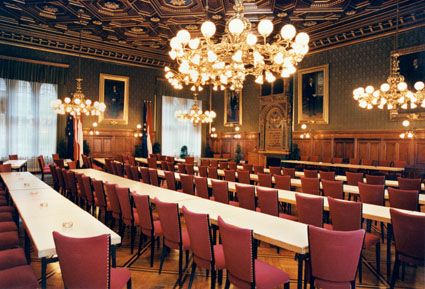
The Council Chamber

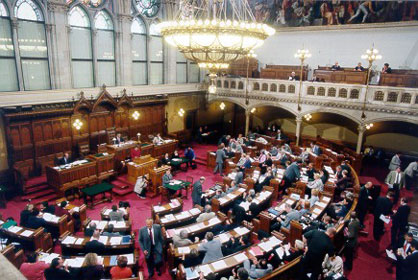
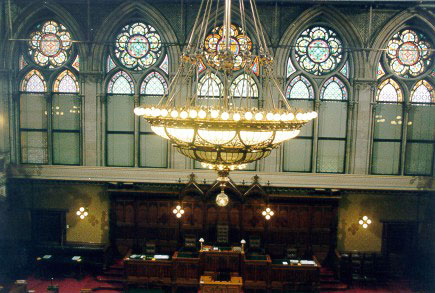
Council Chamber (Photo: Media Wien) Chandelier (Photo: Media Wien) Coffered ceiling (Photo: Media Wien)

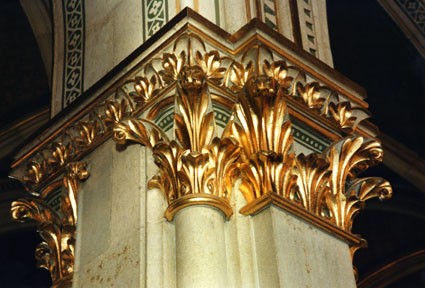
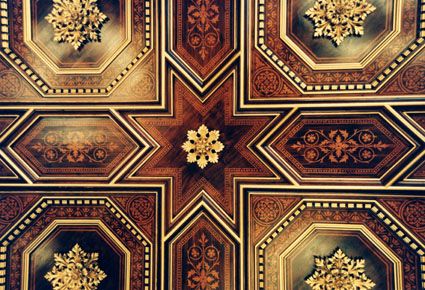
Since Vienna is not only Austria's federal capital but also a federal province in its own right, it is in this hall that the members of the City Council and Diet convene. This assembly is composed of 100 members and elected for a term of five years. The most striking feature of this 14-metre-high room is a huge chandelier in the historicist style, with a diameter of five metres and 213 lights. It was cast in one piece, weighs 3,200 kilogrammes and can be entered by maintenance personnel to change the lamps. The coffered ceiling of high-grade larch and spruce wood is decorated with 22-carat gold-leaf rosettes. Directly below the ceiling, a series of frescoes depicts events from the history of Austria and Vienna. The section situated on the right hand of the central visitors' gallery shows scenes from the 13th to 16th centuries; we see Duke Rudolf IV laying the foundation-stone for the southern spire of Saint Stephen's Cathedral and the establishment of Vienna University, the world's oldest university where students are taught in the German language. The left-hand side takes us into the 17th to 19th centuries. Empress Maria Theresa is surrounded by famous exponents of the politics, arts and sciences of her era (including Emperor Joseph II, Mozart, van Swieten and Haydn). Most of the pointed-arch windows with stained lead glazing facing the gallery were reconstructed after the Second World War on the basis of the original plans. The back wall of the central visitors' gallery depicts the tasks of Vienna's municipal administration in allegorical form.

The huge chandelier was moved one single time in its history. The heat from its lamps transformed the Council Chamber into an impromptu sauna. So it was decided in the 1960s to pull up the chandelier by one metre.

The Festival Hall

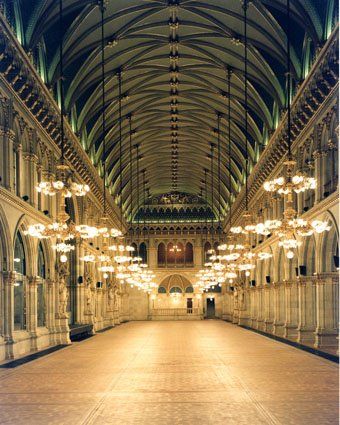
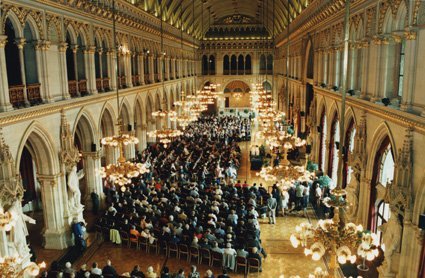
The Festival Hall (Photo: Media Wien) The Festival Hall (Photo: Media Wien) The Festival Hall (Photo: Media Wien)

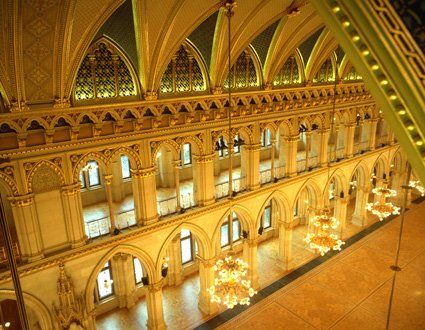
When it was built in the late 19th century, the Festival Hall was the biggest hall in the whole country - 71 metres long, 20 metres wide and 18.5 metres high. It is mainly used for large-scale events such as balls, concerts, exhibitions, et cetera. The ceiling of the hall was designed as a barrel-type vault with web compartments and raised cross ribs as decorative elements. On the Rathauspark side, there is an open loggia with windows; the courtyard side features a projecting corridor spanned by columns. Numerous arcades and the gallery loggia enhance the impression of vast, airy space. Two flights of stairs lead up to the gallery encircling three sides of the hall.

On the front sides of the hall, there are two orchestra niches whose corners are decorated with relief portraits of four great composers: Mozart, Haydn, Gluck and Schubert. Brilliant lighting is provided by 16 magnificent chandeliers. The parquet of the Festival Hall is under monument protection. It maintains its original outlook and was made of special oak preserved for centuries in upland bogs. The wrought-iron grilles inserted into the flooring serve to heat the Festival Hall. Another artistic gem of the Festival Hall are the ten statues representing important historical figures set into the arcade columns.

The Festival hall offers a lot of space. Theoretically, 1,500 couples could waltz simultaneously across its parquet - too bad the Building Inspection Department does not permit it.

The Festival Hall (Photo: Media Wien) Window of the Festival Hall (Photo: Media Wien) Detail of the Festival Hall (Photo: Media Wien)

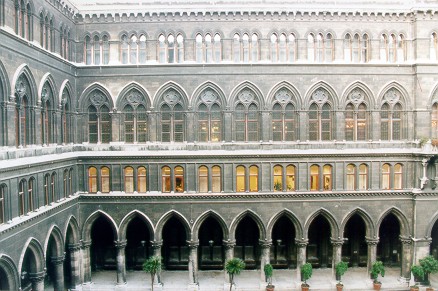
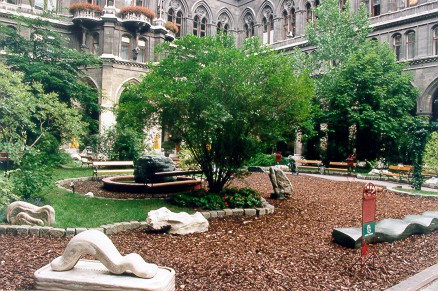
The Arkadenhof

Arkadenhof (Photo: Media Wien) Arkadenhof (Photo: Media Wien) Arkadenhof (Photo: Media Wien)

With a surface of 2,804 square metres, the Arkadenhof is one of the biggest inner courtyards in Europe and comparable to the courtyard of the Doge's Palace in Venice. A choir-type oriel along its western wall is a reminder of the original project to build a chapel in the City Hall. Below this oriel, Friedrich Schmidt's craftsman's emblem is a memento to the architect of the building. Lined by five-metre-wide, pointed-arch arcades, the courtyard offers a fascinating setting for a wide variety of events. A folding roof designed by the architect Silja Tillner is a new addition to protect visitors against wind and rain.

The Senate Chamber

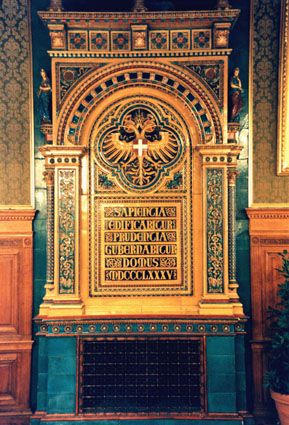
The Senate Chamber The Majolika fireplace Ceiling of the Senate Chamber

In line with Friedrich Schmidt's original design, the Senate Chamber serves as the meeting-room of the City Senate. A special attraction of this hall is the beautiful majolica fireplace - a present by the Guild of Stove and Fireplace Makers dating from 1885 - on the wall facing the entrance to the hall. This is one of the most impressive rooms of the City Hall. The walls are covered with green silk damask. The ceiling - which features inlay work and gilt elements - is intricately and richly adorned. Another remarkable characteristic is the gallery of Mayors' portraits, which after the First World War replaced likenesses of the Austrian Emperors. The collection of Mayors' portraits begins in 1853 with Johann Kasper von Seiller. The likeness of the last Mayor to die is given a place of honour on the front wall of the hall. In the course of time, the portraits are thus transferred, one by one and in the clockwise direction, to the Red Salon, from where the oldest are relocated to the Historical Museum of the City of Vienna.

The entrance to the Senate Chamber is decorated with busts of Johann Strauss and Ferdinand Georg Waldmüller. Four marble plaques on the walls list the names of all Honorary Citizens of the City of Vienna (from 1797 to the present).

The Stone Halls

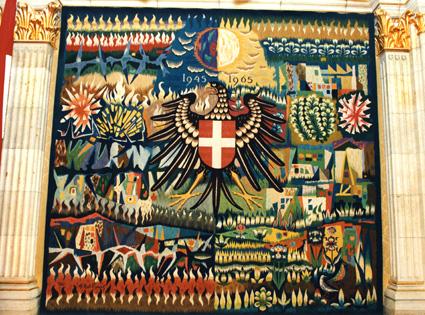
Tapestry in the Stone Hall I (Photo: Media Wien)

The Stone Hall I (Steinsaal I) is mainly used for marriage ceremonies and press conferences. A tapestry depicting the reconstruction of the city after 1945, the coat-of-arms of Vienna and a painting (View of Vienna, 1890) create an atmospheric setting for these events.

The Stone Hall II (Steinsaal II) is adjacent to the Great Coat of Arms Hall and often provides an impressive setting for marriages.

The Nordbuffet

Smaller rooms - the Nordbuffet and Südbuffet - adjoin the Festival Hall to the north and south. Originally conceived as salons for celebrations of the nobility, they were later transformed to house chamber music performances and buffets. Today the Nordbuffet is used as a conference venue. Silk damask tapestries, splendid cut-glass chandeliers and the ornately carved, gilt ceiling made of such expensive woods as Brazilian rosewood and mahogany endow this room with a special atmosphere. The Südbuffet contains the office of the Mayor.

The Coat of Arms Halls

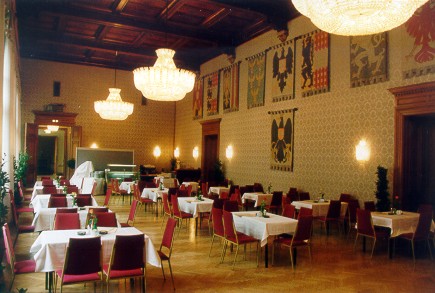
Coat of Arms Hall (Photo: Media Wien)

The Coat of Arms Halls (Wappensäle) were given their modern outlook as late as in the 1960s. Until then, the premises housed the collections of the municipal arsenal, which were later relocated to the new building of the Historical Museum of the City of Vienna in Karlsplatz square. The "Little Wappensaal" features wall-hangings representing the coats-of-arms of all nine federal provinces and the Republic of Austria. Its larger companion offers us a glimpse of the stylised coats-of-arms of the provincial capitals. Moreover, both halls impress with ornate coffered ceilings (inlay work), massive lead-crystal chandeliers and silk damask tapestries under monument protection.


The Grand Staircases

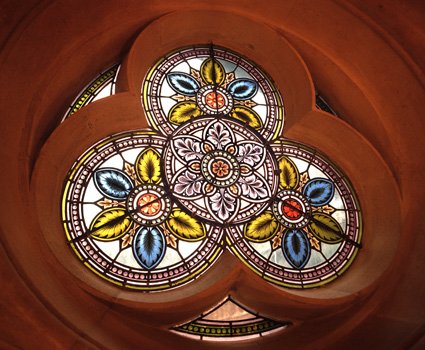
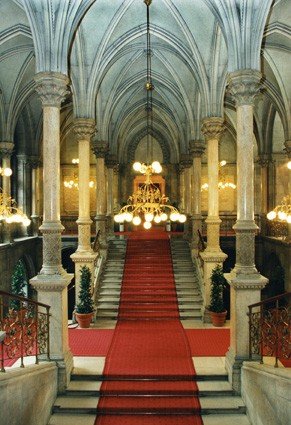
The Grand Staircases (Photo: Media Wien) The Grand Staircases I and II are amongst the architectural highlights of the City Hall. As everywhere in the building, stones from different regions of the Austro-Hungarian monarchy were used. The broad, steep flights of stairs with wrought-iron railings are bathed in brilliant light effects created by the multicoloured tracery windows. From between columns and pointed-arch vaults, visitors may enjoy a variety of aspects of these magnificent stairways. At mezzanine level, we find the longest cloakroom of Austria, designed in the historicist style. The coat-of-arms of Vienna, conferred on the city by Emperor Frederick III, is chiselled above the entrance to the Festival Hall (via Grand Staircase I).

The cloakroom at mezzanine level of the Grand Staircase I is 50 metres long and can accommodate up to 1,700 hangers.

I guess that that was a lot more information than I originally thought it was. But that's good, because now when things are mentioned in my photo captions, you'll know what I'm talking about. I hope.

And I'm going to add more about the Ball Season in here because I don't think I did it justice the last time I wrote about it. It's also going to be short because I have an interview tomorrow and it's almost midnight here.

We'll start off with a bit more about the Hofburg, where the Technische Universität hosted their ball.

Hofburg Imperial Palace is a palace in Vienna, Austria, which has housed some of the most powerful people in Austrian history, including the Habsburg dynasty, rulers of the Austro-Hungarian empire, and currently serves as the official residence of the President of Austria. It was also known as the winter-residence, while Schönbrunn Palace was the preferred summer-residence.

The Hofburg area has been the documented seat of government since 1279 for various empires and republics. [1]

The Hofburg has been expanded over the centuries to include:

The Hofburg faces the Heldenplatz ordered under the reign of Emperor Francis Joseph, as part of what was to become a Kaiserforum that was never completed.

Numerous architects have executed work at the Hofburg as it expanded, notably the Italian architect-engineer Filiberto Luchese (the Leopoldischiner Trakt), Lodovico Burnacini and Martino and Domenico Carlone, the Baroque architects Lukas von Hildebrandt and Joseph Emanuel Fischer von Erlach (the Reichschancelry Wing and the Winter Riding School), Johann Fischer von Erlach (the library), and the architects of the grandiose Neue Burg built between 1881 and 1913.

The Hofburg in Vienna is the former imperial residence. From 1438 to 1583 and from 1612 to 1806, it was the seat of the kings and emperors of the Holy Roman Empire of the German Nation, thereafter the seat of the Emperor of Austria until 1918. Today it is the official seat of the Austrian Federal President.

The oldest sections originate from the 13th century and were primarily constructed by the last of the Babenbergers or by Ottakar II of Bohemia. Previously the castle of the Austrian rulers had been located on the square called "Am Hof," which is near the Scottish Monastery (Schottenstift).

These oldest sections of the castle form a square, surrounding what corresponds somewhat to today’s Swiss Court (Schweizerhof). There situated are a gothic chapel (Burgkapelle), from the fifteenth century, and the treasury (Schatzkammer)[2], which holds, among other objects, the Imperial Insignia of the Holy Roman Empire (Reichskleinodien) and that of the Empire of Austria. The Imperial Music Chapel (Hofmusikkapelle) is also located in this area. This Swiss Court was built during the reign of Emperor Ferdinand I in the style of the Renaissance. Its famous red-black Swiss Gate (Schweizertor) displays the many titles of Emperor Ferdinand I and the insignia of the Order of the Golden Fleece. The lower section of this wing once accommodated the imperial kitchen.

Although not physically connected to the rest of the complex, the Imperial Stables (Stallburg) of the Hofburg were originally built as a residence for the then crown prince Maximilian II. It is said that Ferdinand I did not wish to house his son under his roof, being that Maximilian had veered towards Protestantism. This structure later accommodated the art collection of Archduke Leopold Wilhelm, the art-inclined brother of Emperor Ferdinand III. This collection forms the core of the later Kunsthistorisches Museum from 1889. Only later were the Imperial Stables used to house the imperial horses, and even today it is still used by the Spanish Riding School (Spanische Hofreitschule).

Across from the Swiss Gate is the Amalienburg, named after Amalie Wilhelmine, the widow of Joseph I. However, this wing had already been in use for more than a century, constructed as the Viennese residence of Emperor Rudolph II in the style of the late Renaissance. Of note is the small tower with its dome and the astronomical clock on its façade.

The connection between the Amalienburg and the Swiss Court is the Leopold Wing which was first erected in the 1660s under Emperor Leopold I. The architect was Filiberto Lucchese, but after the Siege of 1683 by the Turks, the wing was rebuilt by Giovanni Pietro Tencala with an additional floor installed. Through its architecture, this wing still bears a connection to the Late Renaissance. It is in this wing that the offices of the Federal President are located. The lower section of this wing as well as that of the Amalienburg served as the enormous wine cellar for the Hofburg.

Prunksaal and the statue of Joseph II

Originally a free-standing structure, the Imperial Library (Hofbibliothek) was housed on the other side of the complex. Charles VI founded the library, which is now called the Prunksaal, cared for by the Austrian National Library (Österreichische Nationalbibliothek). Its construction was begun by Johann Bernhard Fischer von Erlach and finished by his son Joseph Emanuel in 1735. This magnificent hall contains the book collection of Prince Eugene, an enormous ceiling fresco by Daniel Gran, and statues of emperors by Paul Strudel making this part of the Hofburg its most significant in artistic terms. The exterior decoration with Attika figures was executed by Lorenzo Mattielli in 1726. He placed a statue of Pallas Athene riding on a quadriga above the main entrance. On the left portion of the roof, he situated Atlas, supporting the celestial globe, flanked by Astronomy and Astrology, and on the opposite side, Gaia with the terrestrial globe, flanked by allegories of Geometry and Geography.

An additional father-son collaborative project resulted in the Winter Riding School (Winterreitschule) across from the Stallburg (and where the first Austrian parliament sat in 1848) and in the Imperial Chancellory Wing (Reichskanzleitrakt) across from the Leopold Wing. The latter was originally planned by Johann Lucas von Hildebrandt and accommodated, in addition to the Aulic Council (Reichshofrat), the offices of the Imperial Vice Chancellor (Reichsvizekanzler), who was the de facto prime minister of the Holy Roman Empire since the position of Imperial Arch-Chancellor (Reichserzkanzler)—which the Imperial Vice Chancellor represented—had always been filled by the Archbishop of Mainz since the Middle Ages. After the end of the Holy Roman Empire, this wing housed the apartments of the Duke of ReichstadtFrancis Joseph I. (Napoleon II) and later those of Emperor

The Michael Wing was also planned by Joseph Emanuel Fischer von Erlach, and it serves as the connection between the Winter Riding School and the Imperial Chancellory Wing. However, because the old Imperial Theatre (Burgtheater) stood in the way, these plans remained unrealized until Ferdinand Kirschner built the wing from 1889 to 1893, utilizing a slightly altered plan.

More structures and annexes were successively added. Particularly from 1763 to 1769, Nicolaus von Picassi connected the Imperial Library to the other parts of the Hofburg and its other side to St. Augustine’s Church (Augustinerkirche), and he thus created the present Joseph Square (Josephsplatz), one of the most beautiful locations in Vienna. After the renovation of the Albertina in the 1820s by Joseph Kornhäusel, that section became connected to the Hofburg as well.

In 1809, a part of the old bastion adjacent to the old castle was demolished in the course of the Napoleonic Wars. All the way up to the present Ringstraße, new grounds were laid, in which the neoclassical Castle Gate (Burgtor) was integrated. Within the new walls which were erected in 1817, three gardens were laid: the private Imperial Castle Garden (Burggarten), Heroes Square as a lawn with boulevards, and the People’s Garden (Volksgarten) with the Temple of Theseus (Theseustempel), which, along with the Burgtor, was designed by Peter von Nobile. A further addition from this period (already by 1804) is the Hall of Ceremonies (Zeremoniensaal) by Louis Montoyer, which at that time was a protrusion jutting out of the complex. It was quickly regarded as unpleasant and named the Nose (Nase). However, today it is fully integrated into the New Castle (Neue Burg).

Following the enlargement of Vienna after the demolition of the city walls in the 1860s, the Hofburg had its last great expansion. An Imperial Forum (Kaiserforum) was planned—a two-winged structure reaching beyond the Ringstraße, with the twin museums (Kunsthistorisches Museum and Naturhistorisches Museum) as flanks and terminating at the old Imperial Stables (the Hofstallungen, not to be confused with the much older Stallburg) of Fischer von Erlach. The project was led by Gottfried Semper and later by Karl Freiherr von Hasenauer. The museums were completed in 1891, but construction of the rest of the forum dragged on slowly and conflicted since, besides ostentation, no real function could be found for the enormous construction project. In 1913, the south-west wing, the New Castle (Neue Burg), was completed. However, the Imperial Forum was never finished. In its place, Heroes Square (Heldenplatz) and Maria Therese Square (Maria-Theresien-Platz) were laid. The New Castle wing today houses a number of museums (the Ephesus Museum, the Collection of Arms and Armor, the Collection of Ancient Musical Instruments, and the Museum of Ethnology) as well as the reading rooms of the Austrian National Library and the Hofburg Congress Center of international renown. Equestrian statues of the two most important Austrian field marshals, Prince Eugene of Savoy and Archduke Charles, stand at the foci of Heroes Square. On March 15, 1938, Adolf Hitler proclaimed from the balcony of the New Castle onto Heroes’ Square the “Anschluss” of Austria into the Third Reich (Deutsches Reich).

Of note are the equestrian statue of Emperor Joseph II by Franz Anton Zauner at the center of Joseph Square as well as the statue of Francis I in the Inner Castle Court (innerer Burghof) by Pompeo Marchesi. After the completion of Michael Square, two sculpted fountains were installed on its façade: Power at Sea by Rudolf Weyr and Power on Land by Edmund Hellmer.

On the night of November 26/27, 1992, a large fire originated in the Hofburg in the area of the Redoutensäle on Joseph Square. A part of the roof as well as that of the upper floor burned completely down. Its renovation was completed by 1997, and the newly-rebuilt sections now contain wall and ceiling paintings by Josef Mikl.

And now more about balls in general...Th

The Beginning

Historically, during Fasching the lower classes were allowed to wear costumes and masks and to mimic aristocracy and heads of church and state without fear of retribution for mockery. When things got out of hand, the custom was forbidden, for a while anyway. Even Empress Maria Theresia (1717-1780) decreed at one point that masks would no longer be allowed in the streets; whereupon the revelry was moved indoors.

This was the beginning of the splendid balls, for which Vienna has become so famous and the real business of Fasching is, first and last, dancing, but it is also a season of jollification for the entire city.

The Season

The ball season starts with the New Year's Eve Imperial Ball (Kaiserball) at the Hofburg and ends with the Opera Ball in February. The season officially lasts until Ash Wednesday (Aschermittwoch). But in reality, you may attend a ball as early as November and as late as June.

Something for Everyone

There are some three hundred balls during this period. Of these about thirty are leading social events. The most famous are the Opera Ball, the Imperial Ball and the Philharmoniker Ball, which is organized by the famous Vienna Philharmonics. Others are the Physicians' Ball, the Hunter's Ball, the Flower Ball, the Coffeehouse Owners Ball and the Rudolfina Redoute. Full evening dress is obligatory at these principal events or hunting dress in the case of the Hunters' Ball, though there are some elaborate fancy dress occasions, and a children's costume ball. At the redoutes women are disguised in small romantic eye masks.

There remain the other two hundred and seventy-odd events of the Fasching calendar. These are balls too, for the Viennese must dance always, but they are less expensive, less formal. There are postman's balls, police balls, factory balls, balls organized by every social club in every district of the city; Residents become weary of being asked for subscriptions to subsidize these functions, but no true Viennese would wish it otherwise.

The Ball Season in Vienna: Positive Romanticism

Vienna is the only place in the world where balls, as distinct from the smaller modern dinner dance, still rule the social life of winter. Balls in the Hofburg Palace (Imperial Palace), where the Habsburgs reigned, in concert halls and the Opera House, under glittering chandeliers, among mirrors which multiply the hundreds of dancers to thousands. Balls where evening dress is de rigueur, where each debutante wears a little crown like a prima ballerina, women carry fans, and music and champagne blend with the jewels and color, laughter and wealth.

To the foreigner there is something unreal in any of these balls. We are not accustomed to such positive romanticism. A hundred years ago every court in Europe held receptions such as these; London, Paris, all the capital cities had their seasons in the days when the guests arrived in their own carriages with coats of arms painted on the doors. Now we only know this particular form of gaiety from films and plays and as the background of operetta. Could it ever have existed outside the frontiers of Ruritania? It did, and does in Vienna today.

Alles Waltzer

The past at its best: Lush luxury, true elegance and distinguished manners performed with grace and enjoyed a whole fairy tale night long - that means visiting a ball in Vienna.

Throughout the night, one is surrounded by beauty: Vienna's balls usually take place either in a lovely old mansion, formerly owned by a member of the aristocracy; in a prince's former town palace; or, at the most desirable location in all of Vienna, the great halls of the Imperial Palace (Hofburg). And Vienna's ballrooms are dressed to the hilt, as it were, - quite suitable for the occasion: decked out with thousands of flowers, the walls adorned with magnificent trimmings and ablaze with glittering lights, they evoke an atmosphere of elegance and tradition.

At the more elegant balls, liveried footmen may greet the ball goers, who come attired in gowns that will be discussed in next morning's paper, the ladies bejewelled, the gentlemen in black or white tie, complete with decorations. Fanfares announce the beginning of the ball. To the tune of a formal polonaise, the debutantes of the season and their escorts - the young girls almost always dressed all in white, the young men in white tie and tails - open the ball; until some time ago, the opening of an important ball was the equivalent of a "coming-out" for upper-class debutantes in Vienna.

Nowadays, young people from all walks of society simply enjoy themselves. Some introductory words are spoken by an official and the first dance is invariably a waltz, still danced to perfection by these young scions of society. Only after the opening waltz is concluded does the dance master call out the words everyone has been waiting for: Alles Walzer! ( - Everybody Waltz). It is then that dance floor is turned over to the rest of the guests and becomes the arena of all ball goers. And everybody does indeed waltz - dancing goes on through the night in the main ballroom, even though the secondary rooms may resound with modern dances, maybe a jitterbug, a tango, disco tunes or house beats.

Champagne Flows

Champagne is the drink of the night. And at some balls, being seen by or with the right people counts as much as the good time one is having.

Most balls last until two or three o'clock in the morning, some of them until five. After midnight, a hearty Gulaschsuppe (gulyas soup) may be served to provide strength to the untiring dancers. Usually, it is the "kids" that remain until the wee hours of the morning - their energy seems to be boundless. Going home after a ball? No way! There's still time for a Katerfrühstück, a "hangover breakfast." And if no coffeehouse is open that early (even though some coffeehouses extend their opening hours during the ball season), there's always a hot dog stand somewhere near the ballroom. It is not unusual, during Vienna's ball season, for early risers on their way to work to encounter a group of lively youngsters in splendid gowns and formal suits, in elegant coats with silk shawls wrapped around their necks devouring a hot dog at an all-night Würstelstand.

Vienna's ball tradition also demands a Damenspende, a present for the ladies to take home. Originally, the present was designed to hold the Dance Card where all dances of the night were listed and young men reserved their dance with a particular young lady by writing their name next to the dance they desired. Around the turn of the century, these Damenspenden were unusually inventive - some, signifying the advent of the modern age, consisted of miniature steam locomotives or tiny sewing machines. Today, the Damenspenden may be somewhat more prosaic - an exquisite perfume, a nice waltz CD or a lovely piece of custom jewelry - but still meant as a compliment to the lady.

Vienna's debutantes have prepared for many months for their grand entrance by first attending one of Vienna's elegant dance schools and later rehearsing the opening ceremony and waltz on location. Dance schools such as the famous Elmayer's or Fränzl's, offer "crash courses" for ballgoers visiting from outside Vienna, or outside the country, at reasonable prices.

And of course, visitors to the city don't always travel with a ball gown or tuxedo in their luggage - here, too, numerous rental places specializing in ball gowns and formal wear come to rescue. The Viennese themselves also often make use of them and may rent a ball-gown or two if they are to be seen at different balls during one season.

"I would never marry a woman who dances the Waltz"

All that goes to show that the Viennese love celebrating carnival, the days preceding Lent season, called Fasching in Vienna, which usually last from the beginning of the New Year until Ash Wednesday. Despite the love of the Viennese for festive occasions, it is all the more surprising that Vienna, unlike Venice, Rio de Janeiro or Cologne, does not have an extended period of cavorting in the streets and hardly any parades of masked revelers - one exception being the parade of the "Faschingsgesellschaft" which takes place in a different district of Vienna every year - even though one finds some famous Carnival parades in the Austrian countryside.

This tradition, or lack thereof, goes back to one of Austria's much respected rulers, Empress Maria Theresia (1717 - 1780). Despite being admired by her people, she often played the role of a stern mother figure: she did not approve of the Viennese Fasching of her day, which still included wearing masks on the streets, because brawls and tumult sometimes erupted under the cover of anonymity. Therefore she banned the wearing of masks in the Viennese streets. But she permitted the aristocrats at her imperial court to celebrate with masks inside their own "homes" (which were, in fact, palaces or at least mansions).

After her death her son Josef II, a "People's Emperor" who was even closer to the Austrian people - especially the working class - than his mother, relaxed her rule to include permission for all Viennese to celebrate Fasching indoors, with or without masks.

At that time, balls were rather sedate affairs, with stylized minuets, gavottes, polonaises and other dances involving very little body contact. What no one could foresee was the infusion of a new musical energy that the advent of the waltz brought to Vienna and, thence, to the rest of the world. At first, the waltz was considered exceedingly immoral: the constant invitation of today's dance masters, much to the chagrin of timid young girls and boys, namely Tuchfühlung ("Get closer!") was precisely what outraged the old guard at that time. In 1787, Johann Count Fekete described a ball where waltzing was done: "It was wild and immoral. The women behaved in a Bacchanalian manner, all innocence fled from the place." And the Duke of Devonshire declared unequivocally: "I would never marry a woman who dances the waltz!"

The Waltz Takes Off

However, there was no stopping the popularity of the waltz. And with the appearance of the Strauss dynasty on the international waltz scene, waltzes began to reign supreme in the ballrooms of the world. In 1837, the waltz obtained legitimacy with a royal stamp of approval, when Johann Strauss Father composed and played a waltz at the coronation of Queen Victoria. He later dedicated his Myrtle Waltz to her on the occasion of the wedding of "Her Majesty Queen Victoria to his Royal Highness Prince Albert of Saxe-Coburg."

Throughout the nineteenth century, balls became the order of the day during Fasching for all levels of society - not even the revolution of 1848 put a stop to it; on the contrary: the rising star Johann Strauss Son composed a Revolution March, took it to the barricades - and had to suffer some consequences for it. Later, it was played in Vienna's ballrooms.

Even though every Viennese was now entitled to attend a ball, the Viennese Fasching still mirrored the class system of Viennese society: while the gentry celebrated at their mansions or at the Imperial Palace and the bourgeoisie rented elegant establishments, the rest of the people gathered in inns and taverns near their homes, often on the outskirts of the city.

Toward the end of the nineteenth century, various professions and guilds began to create their own balls: in Vienna, to this day, there is hardly a professional group without its own ball. Waiters, chimney sweeps, pastry makers, hatmakers, detectives, flower girls or chamber maids each celebrated and still celebrate Vienna's Fasching season. One of the liveliest and merriest of all Viennese balls, without a doubt, used to be the Wäschermädel Ball (The Laundry Maids' Ball). Technologists created the Techniker Cercle, physicians the Ärzteball, lawyers the Juristenball. And of course, with coffeehouses experiencing their heyday in Vienna, there was a separate Kaffeesiederball (Ball of the Coffeehouse Owners). Many of these balls are still put on today - and will probably last well into the third millennium.

Have A Ball

There are balls for every taste and (every pocketbook) in Vienna. At New Year's Eve, the elegant Kaiserball (Imperial Ball) at the Imperial Palace (Hofburg), a relatively recent ball, attracts tourists and Viennese alike.

Of course, the crowning glory of Vienna's ball season or, for that matter, the European ball season, has traditionally been the Vienna Opera Ball, held at Vienna's venerable State Opera whose stage and auditorium are transformed into a giant dance floor. This is an event of such magnitude in Austria that it is broadcast live on television - and everybody participates, be it in dazzling ballgowns at the ball itself or watching it in the comfortable surroundings of one's home.

The Jägerball (Hunters' Ball) is a special event, where almost everybody turns up in elegant versions of Austria's native dress. The floor-length dirndls of the ladies are made of velvet and silk and the Alpine jackets of the men of the finest materials.

One of the highlights in this city where music reigns supreme is, of course, the ball put on by the Wiener Philharmoniker at their "home," the Musikverein concert hall: the members of the Vienna Philharmonic Orchestra put aside their instruments and let another orchestra play for them - to dance themselves for a change!

The Rudolfina Redoute is the only masked ball of significant stature in Vienna - and until midnight, the floor belongs to masked ladies: it is ladies choice until then. If your heart is set on an elegant masked ball, of which there are not that many in Vienna, this Redoute at Vienna's Imperial Palace may be your best bet. But if you wish to wear a mask in less intimidating surroundings, you can participate in one of the numerous Gschnasfeste, usually organized by young artists and bohemians, where the motto is: anything goes!

Of course, there are numerous other balls of differing degrees of elegance. They all have some things in common: they are festive, they are fun - and they offer an occasion to dance the night away in three-quarter time.

Alternative Balls

The New York Times devoted an entire article full of praise to the alternative ball scene in Vienna: "Homeless - but my Dance Card is full". As a counterpoint to the glittering, century-old Opera Ball featuring the elite of Europe, some enterprising young people staged a Homeless Ball - the participants showed up in parkas, sneakers and baseball caps. Organized by the homeless magazine Augustin, this ball is a counter-culture response to the famous opera ball (Opernball) - however, it is a fair guess that not many opera ballgoers will visit the Opferball (Victim's Ball) by mistake &ldots;

Different other ideas for privately organised balls appear every year. You have to look for them in the Ballkalender. One was or perhaps still is the Ball des Schlechten Geschmacks, which strived hard to remain true to its name - literally: Ball of Bad Taste - very trashy, bad music, awful clothes. Another one was the Mauerblümchenball: Despite its name no one was left out at the Wallflower Ball - the rule was that colorfully dressed people where not even permitted to enter: only if one wore such drab colors as beige and gray one was certain of admittance. And at midnight, the drabbest wallflower obtained a prize!

The Life Ball, which usually takes place in May, is not only one of the biggest charity events in Europe (all proceeds go to help of victims of AIDS or HIV), but has also become one of the most glamorous events of Europe's social life. Thousands of visitors dance the night away and enjoy fashion shows of international designers as well as live acts, hot music and sexy go gos. There is no doubt that this is the most avant-garde ball in Vienna - it is hip and it is zany!

All Good Things Must End

The official Ball season and Fasching come to an end with Ash Wednesday the beginning of the 40 days of Lent, However there are balls for months to come and you have a chance to waltz into the month of June.

Many thanks to Wikipedia and Virtual Vienna for all their wonderful information. And since it is now slightly after midnight, I'm going to get my shower and get to bed. I have a big day tomorrow!

Love always,
Amanda

PS -- I hope this keeps ya'll busy for the next few days. I'll try to get another post in on Friday night before I leave for Berlin for ten days. My laptop will be staying behind, but I'll have my camera and a notebook so I don't forget anything. :-) Photos will be captioned and hopefully more added in the next few days. If I need to find a new host, I'll post that link too.